Showing posts with label moneyweb. Show all posts

Wednesday, December 6, 2017

DO NASPERS & THE TISO BLACKSTAR GROUP COME FROM THE SAME "WEASEL" DENIAL SCHOOL?

Dear Readers,
Bob van Dijk
         In his column in the Sunday Times, which is part of the Tiso Blackstar (formerly Times Media) empire, Peter Bruce pointed out how Naspers' CEO Bob van Dijk had conveniently passed the buck when MultiChoice, one of Naspers' subsidiaries, came under fire for its dubious involvement with the Gupta family.
         In the latest South African Gupta scandal to surface MultiChoice, the pay TV business, was supposed to have paid the Guptas millions to become part of its DStv satellite service.
         Asked to comment Van Dijk told Moneyweb that this had nothing to do with Naspers, the giant Afrikaans media group, as it was MultiChoice’s baby.
         He told Moneyweb that as they had more than 100 firms they could not investigate every single issue that arose among them.
         “When you own more than 50% of a company you’re in charge,” Bruce told readers. “You’re responsible and you’re accountable.”
         He described Van Dijk’s “weasel explanation” as giving the impression that “ownership simple implies you get most of the profits and that’s where it ends.”
Koos Bekker is the Chairman of Naspers
         It would be nice if Bruce could draw this column of his to the attention of Andrew Bonamour, Blackstar’s CEO, because in my recent dealings with him I don’t think he is one of the Sunday Time’s keenest readers.
         A post I wrote entitled: “Exposed - the Sunday Time’s love affair with a crook”(exposed) was about how the business section of the paper (Business Times) had continued to employ Jim Jones as a freelance writer for eight years after they knew he was dishonest. By coincidence it was Moneyweb, the online financial publication, that he defrauded of the dollar equivalent of R200 000 while working for it as its Mineweb Editor.
         In compiling this I tried to get both the Editor Bongani Siqoko and Ron Derby who heads Business Times, to undertake never to use Jones again. All I got were read reports and nothing more.
         I then contacted Bonamour and after getting some very strange answers to my questions I sent him a copy of my proposed post(media chief) and he replied: “It’s bizarre that you should drag me into this when I don’t choose columnists, nor do I interfere in ST or any publication. Media accounts for 20% of our business. I had never heard of Jim Jones until you emailed me.
         “You are welcome to run whatever story you like.”
         Is this any different from the “weasel” way Van Dijk handled the MultiChoice inquiries?
         In the same edition of the Sunday Times in which one of Jones’ bylines appeared there was a letter from Dave Harris headed “Sunday Times is no holy cow” in which he warned: “The Sunday Times  always needs to take into account its own fallibility, otherwise it may be the case of people in glass houses throwing stones.”
         It would be nice if Peter Bruce remembered this.
         Regards,
         Jon, the Poor Man’s Press Ombudsman who reveals what the Media Club would prefer you didn’t know.

P.S. Weasel means not only the animal but a “deceitful or treacherous person.”


P.P.S. MultiChoice’s morality was again in the news when the Adverting Standards Authority ordered it to stop promoting shows as “new” when they weren’t. This was hardly necessary as every subscriber knows that new shows on DStv are almost as rare as the nearly extinct Brenton Blue Butterfly.


Sunday, October 1, 2017

MEDIA EMPIRE CHIEF ANDREW BONAMOUR'S STARTLING ALLEGATIONS IN DEFENCE OF HIS FLAGSHIP PAPER THE SUNDAY TIMES

Dear Newspaper Readers,
Andrew Bonamour CEO of Tiso
Blackstar Group
          Being in the business of cornering shysters and highlighting inefficiencies would surely have taught the Sunday Times that coming clean was always the best way to defuse any situation.
          But when it had its own back to the wall about employing a crooked journalist it showed it has learnt nothing from its exposés or what it advocates for others.
          Apologising was not in its vocabulary.
          This was disturbingly illustrated after my post: Exposed: The Sunday Times’ love affair with a crook (love affair) was published on my blog on 10/9/2017.
          I pointed out how wrong it was that Jim Jones, the one time Editor of the Johannesburg based Business Day, had continued to be featured as a writer in the Sunday Times’ business section (Business Times) for eight years after he had been publicly exposed as a thief in a 2009 report in Noseweek, South Africa’s only investigate magazine.
          As if that was not bad enough Noseweek also revealed that he had abused his position as one of the paper’s freelances to get his own back by writing a scathing article about Moneyweb, an online financial publication. This was founded by Alec Hogg where Jones had been employed as its Mineweb Editor. Hogg was still there when the firm fired Jones after he stole the equivalent of R200 000 from it.
Bongani Siqoko

          On 21/9/2017 I asked the Sunday Times Editor Bongani Siqoko in an email if he was “big enough to tell me that Jim Jones will not write for the Sunday Times again.” But he wasn’t. I got a read report and nothing more.
          So I put the same question to Andrew Bonamour the Chief Executive of Tiso Blackstar (formerly Times Media) the Group that owns the Sunday Times. I told him I got no answer to my email from his Editor Bongani and gave him the link to my post.
          I added; “I accept that this happened before you took over as CEO (This was in 2012), but that should not stop you from healing the wound to some extent now, by giving me the undertaking that I have asked for.
          “How different in principle is this kind of behaviour by the Sunday Times to what KPMG and the like have been doing, even if it is on a smaller scale?”
          The replies I got were made even more peculiar by the fact that Andrew has been, or still is a director of a host of companies and his areas of expertise include investment banking and corporate finance. They were so odd that I wondered if perhaps they were the work of a hacker.
          Apart from this aspect his assertions had the same tone as the ones Jones displayed when he took Moneyweb apart. Bonamour’s ones however, did not even have a semblance of truth in them.
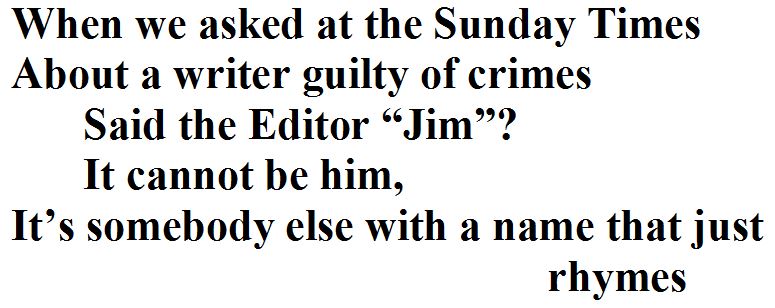
          “Are you sure you have the eighth(sic) person,” his email said. “*Jim Johns bea(sic) was former editor of BD. There is a *Jim Jones who is also a union leader.”
          Business Day is in the same Group as the Sunday Times so I would have expected Bonamour to have got his facts right about Jones’ tenure there. He also should have been aware of what happened to Jones when he was at Moneyweb, and if he didn’t know he could have easily found out.
          In a subsequent email he told me: “You(sic) wrong. Don’t just take Alec Hogg’s word for something.”
          “I’ve got the right person alright,” I replied. I included two attachments from Google that showed that Jones had been the Editor of Business Day and Noseweek had carried an article entitled: High on the Hog. How Jim Jones ripped off his website employer and then spun the story…… Former Business Day Editor Jim Jones.
          “If I had got it wrong,” I told him “I would have expected the Sunday Times Editor and the Business Times Editor to have corrected me by now.”
          Nothing I could do would get him to agree that his biggest selling paper had made a huge mistake in continuing to employ a known crook and that it would not be using him again.
          Having dismissed Hogg as a liar quite unjustifiably, he said something similar about Noseweek in his final email: “Noseweek is hardly a source. They write what they want.”
          So with the Sunday Times in the dock his pathetic defence was to just rubbish the prosecution regardless of the overwhelming evidence against his paper.
Alec Hogg

          Hogg, who is now the Editor and Publisher of BizNews, had this to say when I passed on Bonamour’s comments about him: “I never expected that from him. Sad.”
          He explained that the Moneyweb board had given Jones the chance to repay the money which he did. “I was against it and wanted to press charges but was overruled,” he stated. “They did agree that we would inform the SA Reserve Bank and tax authorities, which we did. I never heard anything more.
          “After he consulted his lawyers Jones’ defence was that I said he could inform our Canadian partners, Infomine, to divert money due to us into Jones’ Mauritius bank account.
          “Your concerns are valid but mud wrestling is an over-rated sport. There is nothing more powerful than the truth and it always wins in the end.
          “I moved on long ago.”
Today 1 October the Sunday Times explained exactly why its editor would not answer my question and why Bonamour was defending the use of Jim Jones even though he doesn’t seem to know who he is. 
Jim Jones

          Jones’ byline was on another Anglo American story on Page 6 of the Business Times. Could we suddenly find him being moved up to the paper’s Mining Editor, after all he did have the title of Mineweb Editor at Moneyweb.
          In the Letters to the Editor in the same edition Dave Harris fortifies my point perfectly. Headed Sunday Times is no holy cow he wrote that the paper had rightly shown no sympathy for KPMG, but we must not forget that by its own admission it had made mistakes in its reporting of the SARS investigative unit.
          “Barney Mthombothi (columnist) writes that the media has done a sterling job of exposing malpractice, while your editorial demands all must come clean and take it on the chin,” he continued.
          “The Sunday Times always needs to take into account its own fallibility, otherwise it may be the case of people in glass houses throwing stones.”
          Well it is certainly not making any admissions in the Jones case. It is doing exactly the opposite to coming clean, or taking it on the chin.
          How long can we expect this love affair to continue? And what will it do to the paper’s reputation, especial among the business fraternity that is well equipped to see the implications of this sort of thing.
          Before I posted this I sent a copy to Bonamour and invited him to make any comments he wished.
          He retorted that it was “bizarre that you would drag me into this when I don’t choose columnists nor do I interfere in ST or any publication. Media accounts for 20% of our business. I had never heard of Jim Jones until you emailed me.”
          It certainly was bizarre that he didn’t mention this in the first place.
Anonymous contributor
          He told me to take this up with the Editor of the Sunday Times and the Editor of the Business Times which I had already done.
He ended by saying: “You are welcome to run whatever story you like.”
So here goes.
          Regards,
          Jon, the Poor Man’s Press Ombudsman, who tells you what the main stream media won’t normally reveal about its fellow club members.

*Note: Jimmy Johns is a substantial American sandwich restaurant chain and James Jones, known as Jack Jones was a well known British trade union leader who died in 2009. Were these the people Bonamour was thinking of when he got Jim Jones’ background so terribly wrong and asked me: “Are you sure you have the eighth(sic) person.”


Sunday, September 10, 2017

EXPOSED - THE SUNDAY TIMES' LOVE AFFAIR WITH A CROOK

Dear Newspaper Readers,
Jim Jones
          Is it reasonable for an investigative publication like the Johannesburg based Sunday Times, South Africa’s biggest selling Sunday paper, to go on using a freelance journalist for eight years after it became aware he was a thief?
          That was not all the paper was aware of. It also knew that he had used his position as a writer for its business section (Business Times) to get his own back on a firm that had fired him.
          Every week this paper has something to say about the wrong doings of others, yet it is blind to its own deplorable morality when it comes to Jim Jones.
          It seems that because he was the Editor of Business Day, a paper in the same group as the Sunday Times for 10 years until 2000 when he was replaced by Peter Bruce, this gave him a clean record forever, regardless of his more recent, shady past.
          In October 2009 Noseweek, South Africa’s only investigative magazine, turned the spotlight on Jones’ thieving ways in an article headed High on the Hogg.
How Jim Jones ripped off his website employer and then spun the story.
          Jones then aged 67 lived mostly in France but still wrote for Business Times as a freelance. In August of that year he cause a stir with a scathing report about Moneyweb, the Johannesburg Stock Exchange listed website that had fired him as its Mineweb Editor.
          It turned out that he diverted $20 489 (About R200 000 then) due to Moneyweb by a Canadian firm into the Mauritius bank account of P.J. News Service, which just happened to be his own company. He only returned the money to Moneyweb after being threatened with a criminal prosecution.
          The Jones broadside described Moneyweb’s performance as “shambolic” with “tumbling” advertising revenue and a debtor’s book that showed an “astounding deterioration.” It could hardly have been more derogatory.
          “The full might of the Sunday Times was brought to bear on our small company with falsehoods published as fact and not so much as a suggestion that we be asked for a response to some of the outrageous claims,” said Alec Hogg the founder of Moneyweb.
Alec Hogg

          “My initial response was to ignore the nonsense. Surely people would see through the axe grinding of a former employee who was forced to repay R200 000 that he had stolen from our company.”
          According to Noseweek the Sunday Times group’s in-house ombudsman Thabo Leshilo was asked to adjudicate. I had found him particularly ineffective when dealing with my own complaints that the Sunday Times was promoting scamsters by accepting their obviously suspect get-rich-quick advertisements.
          In Moneyweb’s case he was no better. Noseweek reported he offered Hogg a 30 cm space in the paper to give his side of the story. This was cut to almost half in the editing and the frivolous headline: Jim Jones a naughty boy indeed, told its own story of how seriously the paper regarded what was a particularly unforgivable thing for a journalist to have done.
          It was a disgraceful whitewash job, with the Ombudsman showing his bias, like a distress flare in the middle of the night.
          At the time Jones’ stories were all over the Business Times together with his impressive byline. Then he became the willow the wisp of the business section as it got smaller and small; disappeared for a time only to reappear now and again at bigger and bigger intervals, but still in its hardly noticeable form as if the paper was hoping nobody would notice he was still a contributor.
          In July 2012 Leshilo’s successor Joe Latakgomo wrote in one of his general columns that appeared periodically in the Sunday Times that the “Media must stick to nothing but the truth” as it derives its “moral authority from being trusted.”
          Ironically the following week Jim Jones’ byline reappeared in Business Times after a considerable absence. So I sent Joe an email referring to Jones and asked: “Can you trust a newspaper that continues to employ someone it knows has a record of this kind.”
          He didn’t even have the courtesy to reply.
          I then wrote a post addressed to Joe dubbed:
                    Sunday Times’ phoney morality (phoney)
It criticised, among other things, the way the paper kept on using Jones.
          In December 2015 I posted:
The Sunday Times badly needs a truth drug injection (truth).
I repeated this story about Jones together with other examples I had personally experienced to debunk the paper’s incredible Editorial boasts in its December 6 edition of how perfect it was.
          This was just after Bongani Siqoko became editor, replacing Phylicia Oppelt who disappeared into management.
          Entitled Our commitment to the truth is absolute the Editorial made claims like this:
          “We want to reassure you, our readers and the public at large, that we adhere to and practise the highest standards of ethical and principled journalism.’’
  
          Like continuing to employ a thief.       

“We have been conscious of and responsive to concerns or complaints regarding anything that appears in this paper as part of our public accountability.”

          Like ignoring my complaints that a thief continued to be employed as a writer.

          If anybody among the top brass at the paper ever read my posts they probably dismissed them as the ravings of an ex-Sunday Times journo who is now well over the hill. How else could they explain the suggestion that they should actually practise what they preach?
          Just when I thought the Sunday Times’ love affair with Jim Jones was finally over HE WAS BACK.

          In last weeks’ edition his byline was on a whole page story in Business Times about the centenary celebrations of the Anglo American Corporation. His return was welcomed as if it was some kind of coup with a mention under the Inside heading on the front of the main paper. JIM JONES Anglo’s century of twists and turns it said.
          Noseweek told us this former mining engineer turned journalist once had his offer to ghost write the autobiography of the late Harry Oppenheimer, Anglo’s Chairman for 25 years, turned down. If only the Sunday Times had been as perceptive? 
          I sent separate emails to the Sunday Times Editor Bongani Siqoko and the Editor of Business Times Ron Derby questioning Jones reappearance and needless to say I didn’t get a reply from either of them.
          It’s understandable. You can’t justify something like this.
The answer is he was not big enough. I got a read report but
nothing else
          Hogg moved on from Moneyweb to found Biznews, which is similar.
          And when I asked him if it was THE JIM JONES who was back at the Sunday Times he replied: “Memories are short.”
          As the Sunday Times itself might say about the Gupta brothers, Jones must have the right connections.
          But whatever the background is, he can only tarnish the paper’s reputation and how can it be sure he won’t use it once again to settle one of his personal vendettas.
          Regards,
          Jon, the Poorman’s Press Ombudsman.

Sunday, December 6, 2015

THE SUNDAY TIMES BADLY NEEDS A TRUTH DRUG INJECTION

Dear Newspaper Readers,
Pearlie Joubert - journo who
started it all
          Today’s Johannesburg based Sunday Times carries an Editorial entitled Our commitment to the truth is absolute. Ha-ha! Ha-ha! Ha-ha!
          This appears to have been prompted by its now ex-journalist Pearlie Joubert who took her own paper to task for what she considered to be the unethical way it conducted an investigation into a rogue unit at the South Africa Revenue Service.
            I won’t go into the details as this has been widely reported elsewhere. The paper of course has stated that her allegations are completely unfounded.


            My concern however is the accuracy of this Editorial. From my own firsthand experience I believe that the paper needs a strong dose of the truth drug.


THAT EDITORIAL

          Here are some of the extremely moral claims it makes for itself in that Editorial. I will then tell you about my experiences with the paper as the self appointed Poor Man’s Press Ombudsman. You can judge for yourself just how honest the Sunday Times actually is.
          “We want to reassure you, our readers, and the public at large, that we adhere to and practise the highest standards of ethical and principled journalism,” is one of them. Ha-ha! Ha-ha! Ha-ha!
          “We have always (take special note of this word) been bound by a code of ethics and acted within the law, and have respected public expectations. We have been conscious of and responsive to concerns or complaints regarding anything that appears in this paper as part of our public accountability system.” Ha-ha! Ha-ha! Ha-ha!


          “Our journalists, editors and other editorial staff are expected to - and have (another word of special note) – operated within these ethical, legal, institutional and professional bounds.” Ha-ha! Ha-ha! Ha-ha!
“All these form part of our values, ethos and our social contract with our readers.
“We have never abused your trust, and never will.” Ha-ha! Ha-ha! Ha-ha!
“We will never forget that we derive our mandate and legitimacy from this public trust. It is required of us that we exercise our power, mandate and duty with the utmost care - ethically and responsibly, holding ourselves to the same standards we expect of others.” Ha-ha! Ha-ha! Ha-ha!
“We constantly remind ourselves that our conduct must never be motivated or influenced by anything other than the public interest.” Ha-ha! Ha-ha! Ha-ha!
“Therefore any insinuation that we have been swayed by anything other than the public interest is baseless.” HA-HA! HA-HA! HA-HA!
VERY LATEST
THIS IS THE BIGGEST JOKE OF ALL. THE DAILY MAVERICK'S
REPORT JUST THREE DAYS AFTER THE "WE ARE SO HONEST"
EDITORIAL
APPEARED

If there is no fiction in all this self praise how does the paper explain the following? For several years until a couple of years ago it had its own in house ombudsman. The first one didn’t last long and nor did the second one. I raised complaints with both of them and got nowhere.
Now they don’t have one at all. My belief is they were causing too much embarrassment. One even made the absurd suggestion in print that corrections should be given the same prominence in the paper as the original story. The paper couldn’t possibly have its mistakes exposed in this fashion could it?
In about 2009 I began what turned out to be a long running campaign on my blog to get the Sunday Times to stop carrying get-rich-quick ads that were so obviously scams because the returns being offered were far, far too good to be true.


I sent my first complaint to Thabo Leshilo the ombudsman at the time.
In an article naming me that he wrote in the paper he indicated that something would be done to ensure these no longer appeared. His view was that “Ads like the rest of the paper had to be believable.”
Inevitably nothing happened. Money was clearly more important to the paper than morality. This made nonsense of the Editorial's claim that “We have been conscious of and responsive to concerns or complaints regarding anything that appears in this paper as part of our public accountability system.”
            In December 2010 I wrote a post headed Poor Man’s Press Ombudsman sensors Sunday Times (sensorship) addressed to the paper’s business journalist Brendan Peacock who had written an article in the business section (Business Times) headed “Hallmarks of a Scam.”
          I asked whether he read his own paper because while it carried his “sanctimonious article on how not to get scammed” it continued to carry ads which were clearly scams as they complied with just about everything mentioned in his article.


          The ads continued to appear and no doubt people who could least afford it continued to lose a life time of savings. So much for the paper’s concern for the interests of the public. (“We constantly remind ourselves that our conduct must never be motivated or influenced by anything other than the public interest.”)
          In September 2011 I wrote another post headed Sunday Times – haven for dubious adverts (dubious ads). This was after I had complained to Leshilo’s successor Joe Latakgomo and he had written an article headed “Beware of dubious adverting claims.”
          In it he said these “erode the public trust in newspapers. We are distressed by the number of scams that infiltrate our pages and cheat our readers. We will continue as journalists to expose those that cheat and lie to our readers.”
Joe Latakgomo writing about my
complaint
          But as far as I know the Sunday Times (I get it every week) did not expose these crooks that were making a packet by advertising in its own paper and nor did it stop taking the ads. You don’t bite the hand that feeds you however rotten that hand happens to be seems to have been its thinking.


Joe again
It’s hard then to understand how that Editorial had the gall to tell us that the paper prides itself as being known for its “ethical, award-winning and uncompromising investigative reporting that exposes wrongdoing.” 


The warning Joe was talking about above that the
     paper seemed to think absolved it from any
     responsibility for what happened to investors
In May 2012 I wrote another post headed Noseweek exposes Dearjon letter (dearjon-letter exposed). It was addressed to Ray Hartley the Sunday Times editor at the time and was a longer version of what I had written for Noseweek, South Africa’s only investigative magazine.
I told Ray that it was “deplorable the way your paper has been promoting crooks for years.”
                 

I referred him to an expose` that had just been aired on the Carte Blanche TV channel. It revealed that Kevin Cholwich and François Buys had defrauded people out of millions and two of the companies they used were Whoopee and Geo Connect. And surprise, surprise these were ones that I had complained about when their ads appeared in the Sunday Times.
One investor, a 47 year old mother of two lost her entire pension of R250 000 accumulated over 10 years of hard graft after she put it into Whoopee.
This might never have happened if the Sunday Times practised anything like what it preaches.
It was only after this that these kinds of dubious ads seemed to disappear from the Sunday Times. Of course it would never admit that I had anything to do with this.


JONES IN NOSEWEEK
       Another shocking example of the questionable morality at this paper involved Jim Jones the former Editor of Business Day in Johannesburg who had been a freelance writer for Business Times.
Nobody it appears had bothered to check his most recent background so when he started writing for the Sunday Times they didn’t know, or if they did they ignored it, that he had been fired by his previous employer, Moneyweb for helping himself to R200 000 of the firm’s money.
Things came to a head when he used his position on the Sunday Times to write a scathing article about Moneyweb, an online financial investment reporting firm that is quoted on the Johannesburg Stock Exchange. The Sunday Times was forced to apologise and a damning Noseweek article exposed him as a crook.


At the time Alec Hogg, Moneyweb’s founder said Jones was fired by his firm and forced to repay the R200 000 he had stolen.
At this stage the Sunday Times could not have had any excuse for not being fully aware that Jones could only damage the paper’s reputation if he continued to write for it, especially in the business section.
Yet it continued to employ him. After disappearing for a while his byline reappeared.
In July 2012 Joe Latakgomo wrote in one of his general columns that appeared periodically in the Sunday Times that the “Media must stick to nothing but the truth” as it derived its “moral authority from being trusted.”
Ironically the following week Jim Jones’ byline reappeared in Business Times. So I sent Joe an email referring to Jones and asked: “Can one trust a newspaper that continues to employ someone it knows has a record of this kind.”
He didn’t even have the courtesy to reply. Was this being “conscious of and responsive to concerns or complaints regarding anything that appears in this paper as part of our public accountability system?”
I then wrote another post entitled Sunday Times’ phoney morality (phoney morality).


At the time of the Noseweek article Jones’ reports were all over Business Times together with his impressive byline. Then it got smaller and smaller only to disappear for a while and then reappear at bigger and bigger intervals before fading out completely. It looked as though somebody was very reluctant to see him go.
SO IF PEARLIE JOUBERT HAS BEEN TELLING FANCIFUL STORIES AS THE PAPER ALLEGES I CAN SEE WHERE SHE GOT THE IDEA FROM – HER OLD PAPER ITSELF, THE SUNDAY TIMES THAT HAS BEEN SETTING SUCH A POOR EXAMPLE.


LATEST, LATEST: This appeared on the front page of the
              Sunday Times just 14 days are after that "We are so perfect" Editorial
Regards,
Jon, the Poor Man’s Press Ombudsman who tries to tell it like it is and not as he thinks people would like to hear it. 


Friday, March 18, 2011

Poor Man's Press Ombudsman in Disappearing Mystery

Dear Judge Ralph Zulman at the South African Press Council,
      Sorry to  bother you again Judge but as the Poor Man's Press Ombudsman I need somebody of your eminence to help me solve two disappearing mysteries at the Sunday Times.
         You will recall that you dismissed my complaints against that paper as being too frivolous to be put before the Council’s Appeals Committee which you head.

          
           My beef was twofold. I felt that it was immoral for that paper to carry dubious get-rich-quick advertisements. This was especially so as its in house ombudsman Thabo Leshilo had written a report indicating that something would be done about them after I had complained to him. But they went on appearing as usual.
          I pointed out that the dubiousness of these ads was compounded because among them the Sunday Times had its own ad warning readers that it could not be held responsible if anybody got burnt by investing in any of these schemes.
          I also questioned the paper's ethics for continuing to employ Jim Jones as a business writer when he had been exposed in Noseweek as having been dishonest when he worked for Moneyweb.
          In recent editions of the Sunday Times its warning advertisement has disappeared although there are still a sprinkling of those suspect investment ads. And where’s the Jim Jones byline which was prominently displayed? It too seems to have gone.
          Perhaps I haven't been looking properly. But if I'm right Your Honour can you explain why this should have happened?
     Why did the paper remove the very things that formed the basis of my complaints to your Press Council not long after you decided  that my moan had no merit? It makes you think doesn't it.          
          Of course had my complaints been upheld by your Council the paper would have had the embarrassment of having to publish the judgment for all its million or so readers to see. Luckily it has been able to quietly sweep everything under the carpet.
          No doubt the paper was hoping that the Poor Man’s Press Ombudsman was drunk again and wouldn’t notice. And even if he did it would not be much of a blow because who reads his blog anyway – only 50 000 people or so. What’s that compared with the vast numbers who follow the Sunday Times each week and believe in its faultless morality?
          After all if a paper spends it's life exposing corruption and the shortcomings of all and sundry it follows doesn’t it that it would not employ a reporter who was suspect and nor would it carry anything that was not entirely believable.


          Ironically while you have been kicking my complaints into touch and these mystery disappearances have been going on at the paper your Council has been having hearings all round the country. Their purpose was to get people to submit ideas as to how your Council could improve its form of home town justice.
          For the life of me I can’t understand why your Council went to all this expense just because our African National Council Government was threatening to introduce some form of censorship and a better body to deal with Media complaints than  your outdated Council.
          All you had to do was to leave it me. As the Poor Man’s Press Ombudsman I work for nothing. I don’t sit idly by while papers contravene their own Codes of Conduct as your Council does.
          Did you see that disturbing report about the results of a National Press Club survey among mainstream journalists in South Africa?  It found that 69% of editorial teams had their own codes of conduct but only 21% said these were referred to regularly. So if they are not bothered about their own ethical rules are they likely to uphold the ones set by your Council?
          It’s precisely this point that I have highlighted on several occasions on my blog. But unlike your Council I don’t wait for a complaint before I act. I’m on the look out for offences 24/7.
          If you feel Judge that any of my conclusions are unfair you are welcome to respond. The last thing I want is for the ANC to accuse me of not doing my job properly, otherwise, before we know it, millions will be allocated to establish a new Blog Policing Agency.
          Yours respectfully
          Jon, The Poor Man’s Press Ombudsman.
PS. In case you need to refresh your memory see Press Council’s Brand of Justice Part I & II on my blog.

Tuesday, February 22, 2011

Press Council's brand of Justice - Part I

Dear Newspaper Readers,
          This is the first of a two part series on the spat the Poor Man’s Press Ombudsman has had with Big Brother, the South African Press Council. It threw my complaints against the Sunday Times out on their ear.
          They only got to second base where former judge Ralph Zulman, the head of the Appeals Panel decided they didn’t merit consideration by the other members of that body. He refused me leave to appeal.
          He inadvertently introduced humour into this solemn occasion when he emailed me his finding. When I told him I couldn’t open it he sent it to the Council’s offices to have it passed on only to receive this reply, Judge please fax us your decision as we also can’t open the attachment.
          The Press Council’s inefficiency was highlighted once again at the bottom of the fax I finally got when the judge added; I regret the delay in this matter. The relevant papers only reached me last week.
          That was nearly four months after I had lodged an appeal after my case had been dismissed by Dr Johan Retief, the Deputy Ombudsman.
          The Council can dawdle along but aggrieved readers are expected to complain within 14 days of a disputed article appearing and lodge an appeal within seven days if the Ombudsman’s decision is disputed.
          Let’s be serious; it’s no laughing matter for the Sunday Times, with its vast circulation, to be dragged before the Press Council to have it’s morals questioned by this nobody who calls himself the Poor Man’s Press Ombudsman. After all isn’t the Sunday Times such a pillar of rectitude that it is entitled to police everybody else’s behaviour?
          The Council (slogan: Effective self-regulation is the best system for promoting high standards in the media) holds itself up as a shining example of how well it’s brand of justice works. It adjudicates on complaints against the mighty Press, or the Fourth Estate if you want to be posh.
          You’ll never see a report in any paper of my case because papers are only compelled to publish the result when the complaint is upheld. The centuries old maxim that justice needs to be seen to be done gets conveniently bypassed. It’s a cosy arrangement to avoid embarrassing papers that are always attacking Government and other organisations for trying to keep their secrets.
          Complainants are kept pretty well in the dark about what is going on behind the scenes. They don’t get a copy of the allegations that have been put to the accused and nor are they given full details as to what the defence is maintaining.
          Here’s what happened when I took the Sunday Times to task over stories that appeared in the Business Times section of that paper so you can judge just how good or bad this keep-it-in-the-family system works.
          Apart from the newspaper itself my other antagonist was Thabo Leshilo, an impressive heavyweight in South African journalism. Harvard educated he had been editor of the Pretoria News and Business Times and Editor-in-Chief of the Sunday World and the Sowetan.
          He became the Public Editor for the Avusa Group, which owns the Sunday Times among other publications, more than a year ago. He was billed as the person who takes up complaints on behalf of readers, making him the Group’s in-house ombudsman. So it was to him that I directed my concerns.
·       First Complaint. I drew his attention to the dubious investment advertisements that were appearing in the Sunday Times because I felt that a lot of people, particularly pensioners, often got tempted by these get-rich-quick schemes and ended up losing everything. The paper clearly had its doubts about these ads because it warned readers to be careful where they put their money as the paper could not vouch for the claims made by advertisers.  Leshilo evidently agreed with me. The half page report he wrote that appeared in the Sunday Times mentioned my name and that the Group’s advertising manager had agreed to be choosier about accepting this type of ad. Leshilo wise words were that ads, like the rest of the paper had to be believable. The new policy did not last long before it reverted back to type with promoters promising investors ‘30% interest’ on their money and other too-good-to-be-true opportunities.
·       Second Complaint. Noseweek, South Africa’s investigative magazine carried a story headed High on the Hog. How Jim Jones ripped off his website employers and then spun the story. It told how this former editor of Johannesburg’s Business Day, who was now writing for the business section of the Sunday Times, had pocketed $20 487 belonging to Moneyweb, his ex-employer. The spun story he wrote in the Sunday Times was a scathing attack on Moneyweb and was evidently an act of revenge because he had been fired by this firm. The white washed apology the paper carried under Jone’s byline conveniently left out the fact that he had departed from Moneyweb under a cloud. I asked Leshilo, Why is Jones still employed by the Sunday Times and isn’t it particularly hypocritical to keep him on as the paper is in the business of exposing corruption. I referred to an article Leshilo had recently written entitled, Journalists who dirty their hands subtitled A few scoundrels can tarnish the credibility of an entire industry. He went on to say, The big problem though, is the way the media handles their ignoble sons and daughters. Referring to another case he had been dealing with he added, I have never seen such foot-dragging, buck passing and abdication of responsibility on something so damaging to the credibility of a newspaper.  After I had emailed him several times to find out what was happening he assured me, I’m not sweeping the Jim Jones matter under the carpet. But that’s exact what happened because Jones continued to write in the Sunday Times and its sister paper The Times with bigger and bigger bylines.
·       Third Complaint. This was prompted by an SMS from Laurie that appeared in The Times. He maintained that judging by the columns Leshilo had written he was not dealing with any complaints. I then asked him, Isn’t it time that your Group admitted that you are just another columnist and that if readers want to complain you are not the person to contact. He replied that he had been agonizing over this.
         To be continued.
          Yours sincerely
          Jon, a Free Blog advocate. 
Add caption

Buy my book 'Where have all the children gone?' on Amazon.com It's a thriller with an underlying love story.